




.png)


.svg)
.svg)

%20Opengraph.png&description=CLOC+Global+Institute+2026+moved+past+%22should+we+adopt+AI%3F%22+Here%27s+what+legal+ops+leaders+are+actually+building+%E2%80%94+and+the+frameworks+guiding+them.)

%20Hero.png)

16 minute read
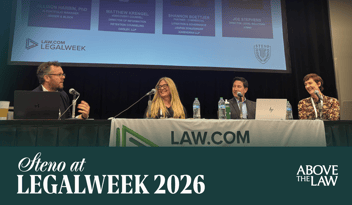
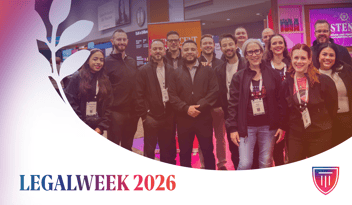
When Above the Law stopped by our booth at the CLOC Global Institute, they asked the Steno team for one word to sum up the event, held May 11–14 in Chicago.
The answer came quickly: Collaboration. Everywhere we looked, we saw in-house teams trading notes with vendors between sessions, law firms asking corporate clients what was actually working, general counsel sitting in on legal ops sessions, and legal ops leaders attending GC sessions.
CLOC chose "Stronger by Design" as the theme this year, and across 2,400 legal operations professionals, the strength on display was less about individual firepower and more about what people were willing to share with each other in the spaces between the programming.
From ‘Inflection Point’ to ‘Stronger By Design’
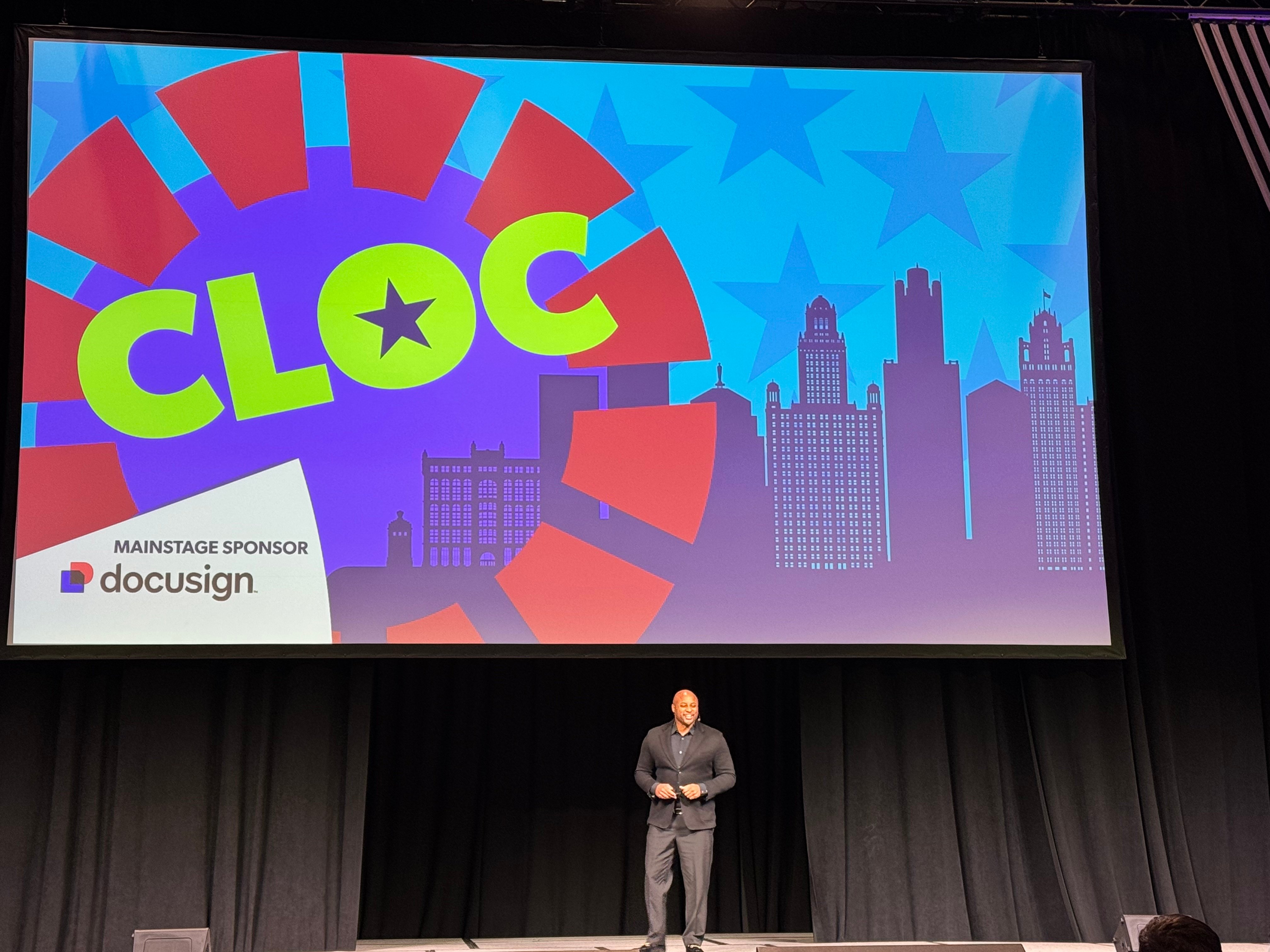
CLOC President and CEO Oyango Snell kicking off CLOC Global Institute 2026.
CLOC President and CEO Oyango Snell opened with an idea that was both quietly contrarian and critically important. As he explained it, we keep hearing the phrase “we're at an inflection point,” used to describe the current state of legal ops. The problem, however, is that statement makes legal ops sound like it's sitting at the edge of something, waiting for the right moment.
Snell reframed it as a call to action. "We are the changemakers of today and tomorrow, not as individuals, but as a community,” he said. “We build for each other. We support each other. It's not about commiserating. It's about moving us forward."
The General Session keynote carried that energy forward. Sharing the stage with Docusign CLO Jim Shaughnessy, Zack Kass, Global AI Advisor and former Head of Go-To-Market at OpenAI, Kass framed his keynote, entitled The Next RenAIssance, around a powerful thought: “AI is not the story. Humanity is,” he said. “AI is the brush. Humanity is the masterpiece."
From there, he asked the question that became the conference’s most-quoted line: “If you could automate everything in your life, where would you stop?”
For lawyers specifically, he offered two companion questions. At what point does the lawyer intervene? How do we protect what we value most? Cowen Group President David Cowen called them out in his recap of the week, and they came up, one way or another, in nearly every conversation we had with attendees who visited our booth.
Anthropic Goes All-In on Legal
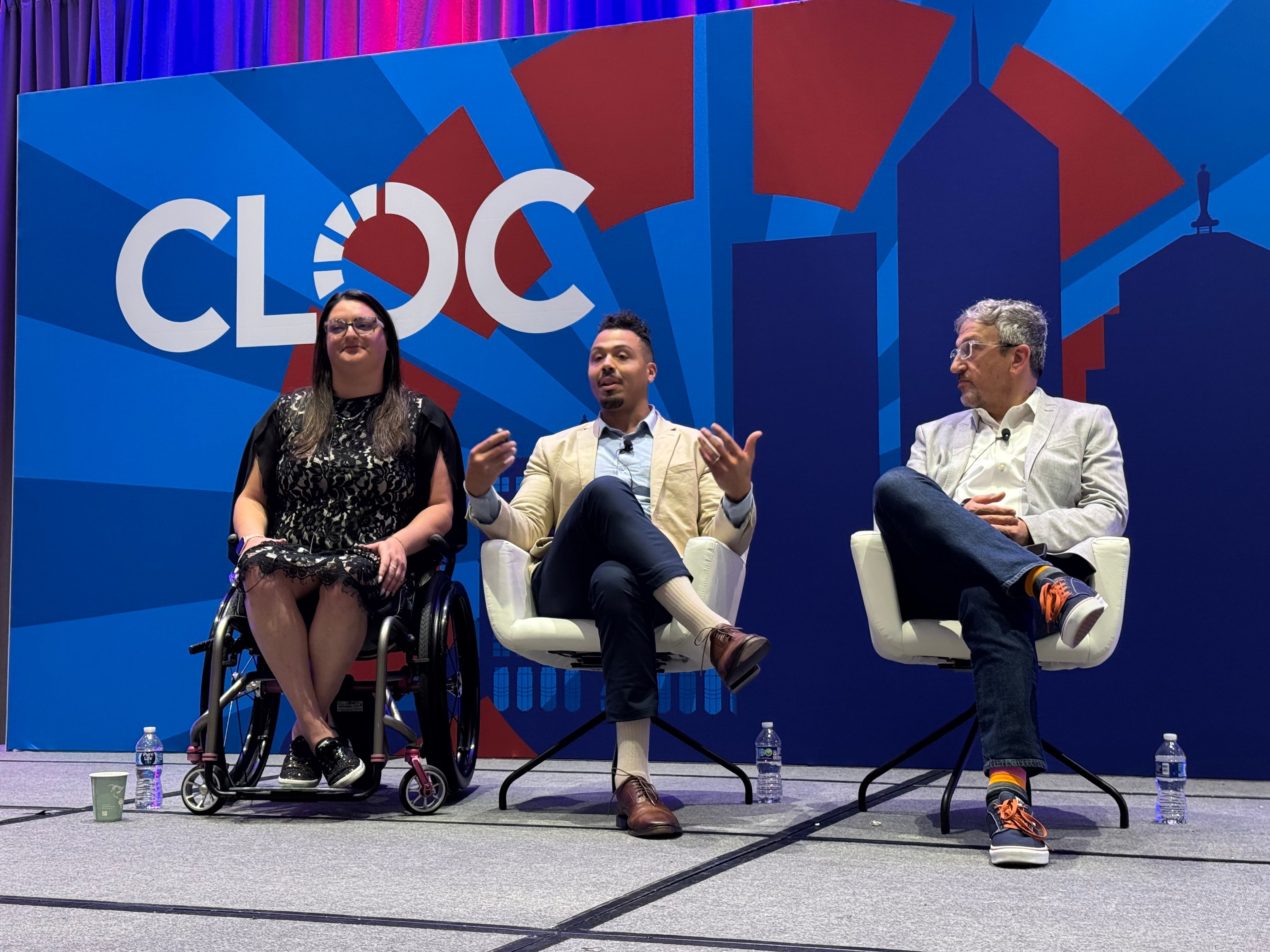
Lydia Petrakis (Microsoft), Trent Mosley (Anthropic), and Chad Ergun (Womble Bond Dickinson) on the CGI 2026 stage.
The biggest legal tech news of the week broke on the second day of the conference, when Anthropic launched Claude for Legal, the company's most aggressive push yet into the legal vertical. The announcement bundled three things together:
- More than 20 new MCP (Model Context Protocol) connectors wiring Claude into the software that law firms and corporate legal teams already run on, including DocuSign, Everlaw, iManage, Box, Harvey, and Thomson Reuters' CoCounsel Legal, among others.
- 12 practice-area plugins tailored to specific legal disciplines. Commercial, privacy, corporate, employment, product, AI governance, M&A, contract review, and regulatory research, among others.
- A statement of intent. Anthropic noted that since this February’s legal-plugin release, legal professionals have been most engaged users of Claude Cowork than any other knowledge-work function.
The launch reframed the afternoon panel a few hours later. CoPilot, ChatGPT and Claude: 12 Use Case Scenarios for In-House Teams brought together Trent Mosley (GTM, Anthropic), Lydia Petrakis (Assistant General Counsel & Digital Strategist, Microsoft), and Chad Ergun (CIO, Womble Bond Dickinson). They presented side-by-side comparisons of Copilot, ChatGPT, and Claude using real-world in-house workflows, including privilege logs, discovery response drafting, employment policy work, due diligence, litigation hold notices, invoice narrative analysis, and patent landscape analyses.
The framing that most resonated was Mosley’s argument for an "AI Constitution." He noted that agentic AI moves through three distinct architectures:
-
Human in the loop. The lawyer does the work; AI assists at the margins.
-
Lawyer in the loop. AI does the work; the lawyer reviews and decides.
-
Agent in the loop. The agent acts; the lawyer is brought in only when defined criteria are triggered.
To succeed across all three, organizations will need explicit, written principles for how their AI is deployed, who is accountable for outputs, and where the lawyer intervenes.
With Anthropic's connectors now generally available and Microsoft's Copilot embedded in the productivity stack most legal teams already use, the friction for legal ops leaders is no longer about getting access to the tools, but whether they have the governance, accuracy benchmarks, and workflow design to deploy them responsibly.
“What used to cost weekends is now done in minutes.”
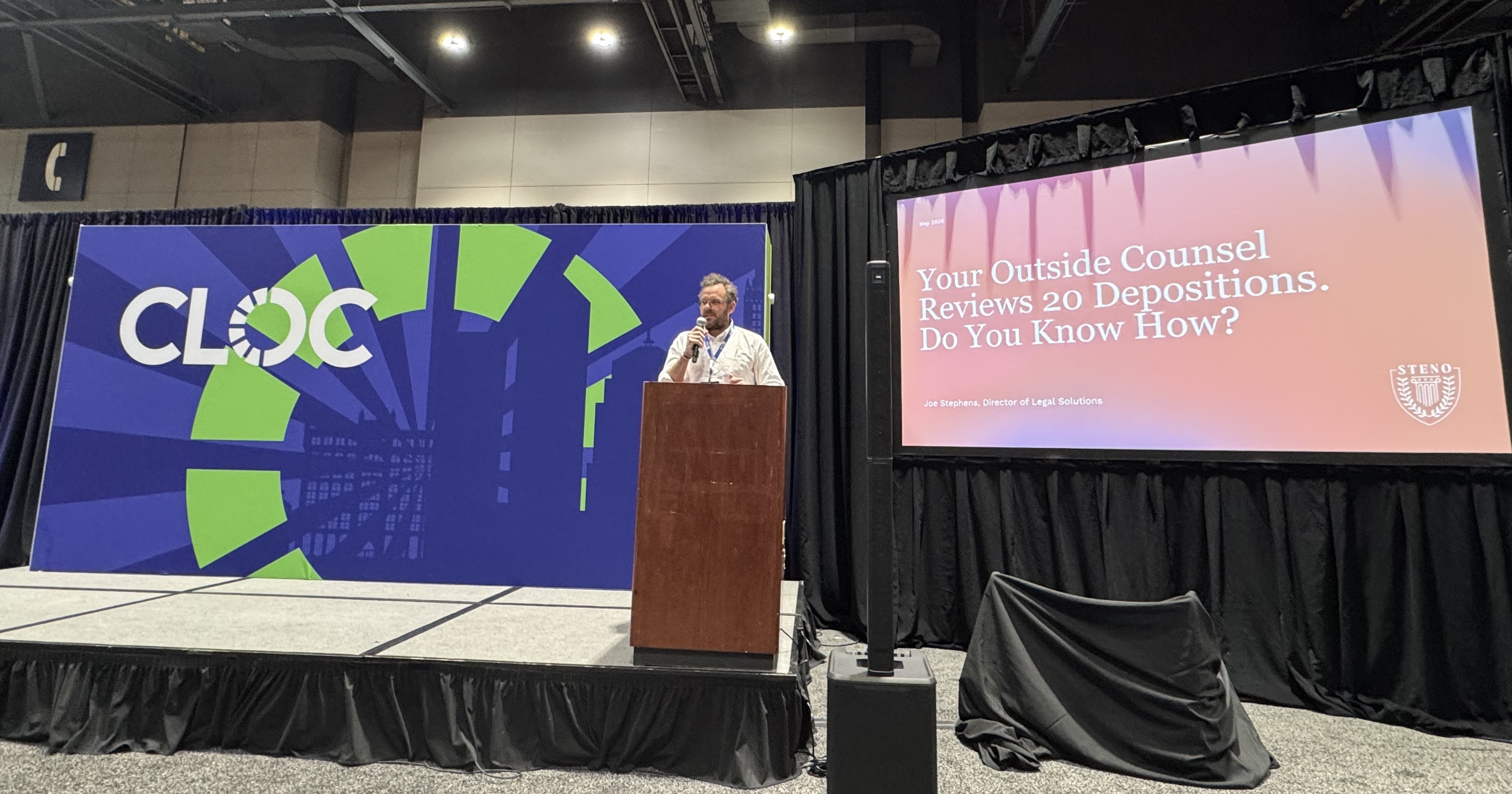
Steno's Joe Stephens presents the CGI 2026 Legal Hack: 'Your Outside Counsel Reviews 20 Depositions. Do You Know How?'
Depositions are among litigation’s largest cost centers and one of the least transparent. Once transcripts leave the court reporter, in-house teams usually have little visibility into how outside counsel uses them. They have no idea how long review takes, whether key testimony is being fully leveraged, or where the contradictions are.
Steno Director of Legal Solutions Joe Stephens tackled this problem in an AI Legal Hack session titled Your Outside Counsel Reviews 20 Depositions. Do You Know How?
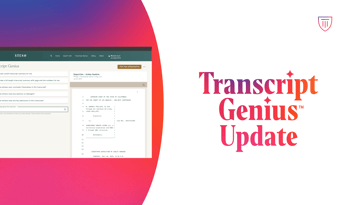
Joe opened by stating, "What used to cost weekends is now done in minutes." Over the fifteen minutes, he demonstrated how Transcript Genius can sequentially:
- Scan hundreds of pages of testimony in seconds to surface key issues, contradictions, and credibility gaps
- Generate customizable summaries with linked citations, so every AI output is instantly verifiable
- Interrogate multiple depositions simultaneously to compare witness accounts and build case strategy
- Cut two to four hours per case from review time, which translates into something a legal ops dashboard can actually defend in a budget conversation
But Joe's bigger point was about the challenge of thoughtfully deploying technology across specialized workflows rather than taking a generic approach. "That's what makes it powerful, and that's what leads to things that matter," he said.
He was talking about things like finding evidentiary needles in a haystack buried in expansive testimony, making more impactful arguments in the courtroom, and winning jury trials in bet-the-company litigation. Joe has managed complex litigation across twelve counties with limited resources, and he was talking about a workflow he's actually run.
A version of the same idea came up later in the week when Joe spoke to David Cowen for his Careers and the Business of Law podcast. In a year when the legal AI category is being commoditized at the model layer, that distinction—between what a tool does and how the work feels on the other side of it—is the part Steno has been investing in the longest.
The Frameworks Conference
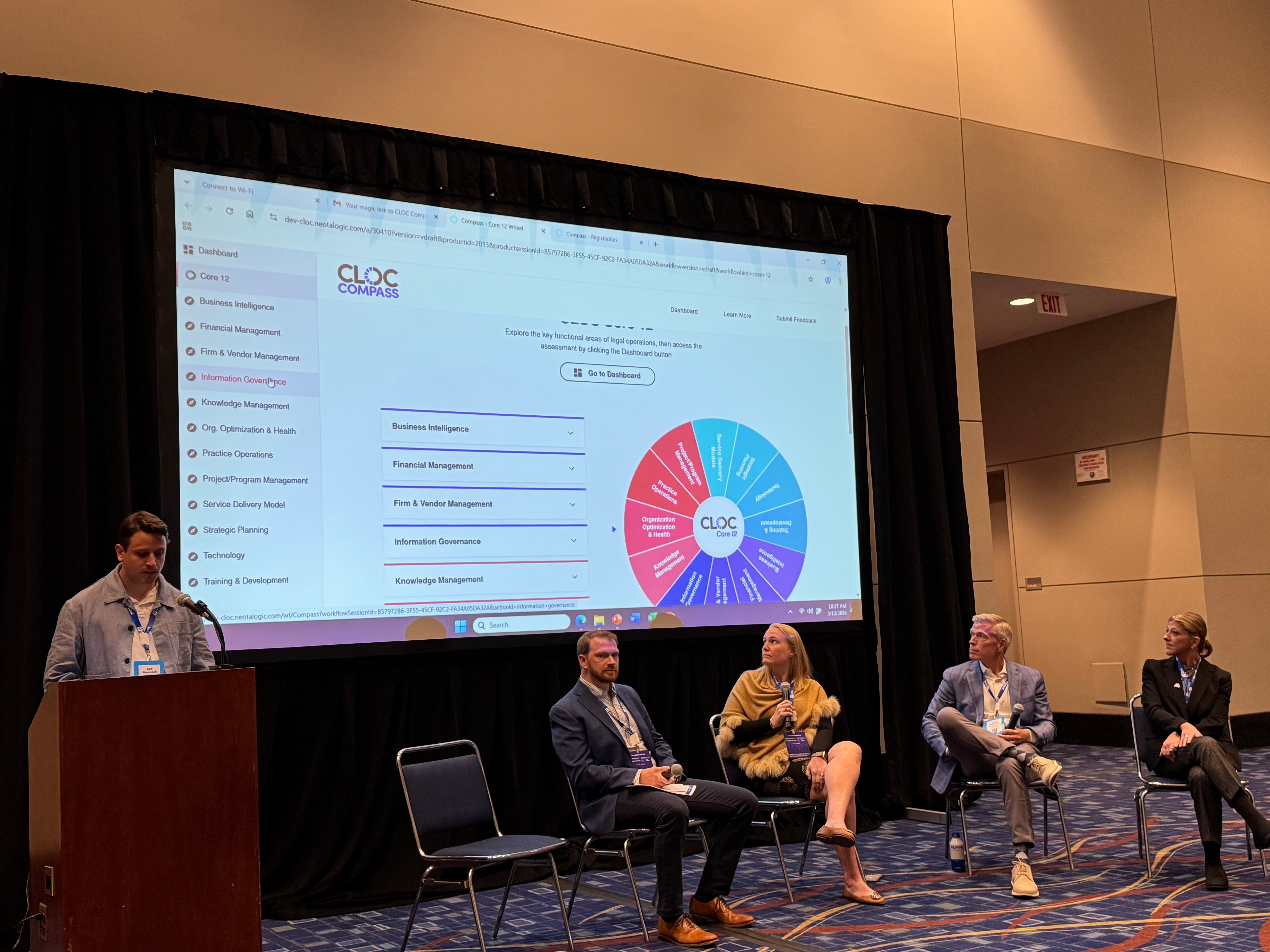
The CLOC Compass interactive working session.
The "should we adopt AI?" question has been settled. The one that presenters and attendees kept coming back to was, "How do we measure whether we're using it well?" More than anything else, CGI 2026 was a frameworks conference, and we counted four that are worth highlighting.
The CLOC Compass
The CLOC Compass was introduced and demonstrated by Dr. Amy Thomsen (Director of Content and Curriculum, CLOC), Kevin Bielawski, Lindsay Staples (Head of Legal Operations, Beta Technologies, Inc.), and the Neota team. The Compass plots a department's maturity across four areas (Business Intelligence, Financial Management, Firm & Vendor Management, and Information Governance) through four stages (Reactive, Emerging, Developing, and Leading).
Staples explained that the Compass turns a manual maturity assessment into a repeatable, quantifiable, and data-driven artifact linking back to specific CLOC resources that you can hand to your GC. Bielawski added it works just as well inside law firms, both as a self-assessment tool and as a way to educate partners on what legal operations does and why it matters.
Four-Pillar AI Value Framework
The conversation about AI in legal has finally moved past cost savings and into capability creation. How value is defined will shape how legal services are evaluated, priced, and sourced. Mike Haven, Global Head of Legal Operations at Meta and former CLOC President, shared the four pillars his team uses to evaluate AI investments:
- Deflection: Legal embedded into business workflows
- Internal Focus: Less need for external support.
- Organizational Efficiency: Reduced internal resource needs
- New Capabilities: Net new business impact.
Three-Core Governance Framework
Christopher Chan, General Counsel for Technology at Jones Lang LaSalle, walked through the three principles his team built into their AI governance program, with reports, use, and guidelines that are updated quarterly:
- Safe to use
- Ethical use
- Human-centered
Judd Kessler's "Three E's"
Wharton behavioral economist Judd Kessler delivered the closing keynote, The Power of "Hidden Markets." He offered a framework that goes beyond AI to ask: How do you design any system that allocates a scarce resource? His criteria:
- Equity. Are we treating people fairly?
- Efficiency. Are we wasting resources, or sending them to their best possible use?
- Ease. Are the rules manageable, or are we making market participants go through an ordeal?
Kessler's reframe was the one that stuck. Your time and attention are scarce resources, and you are a market designer. The first-in-time, first-in-right rules that govern your recurring meetings, your inbox, and your team's access to your calendar are markets designed, often unconsciously, by you.
The Pricing Question Is Actually a Value Question
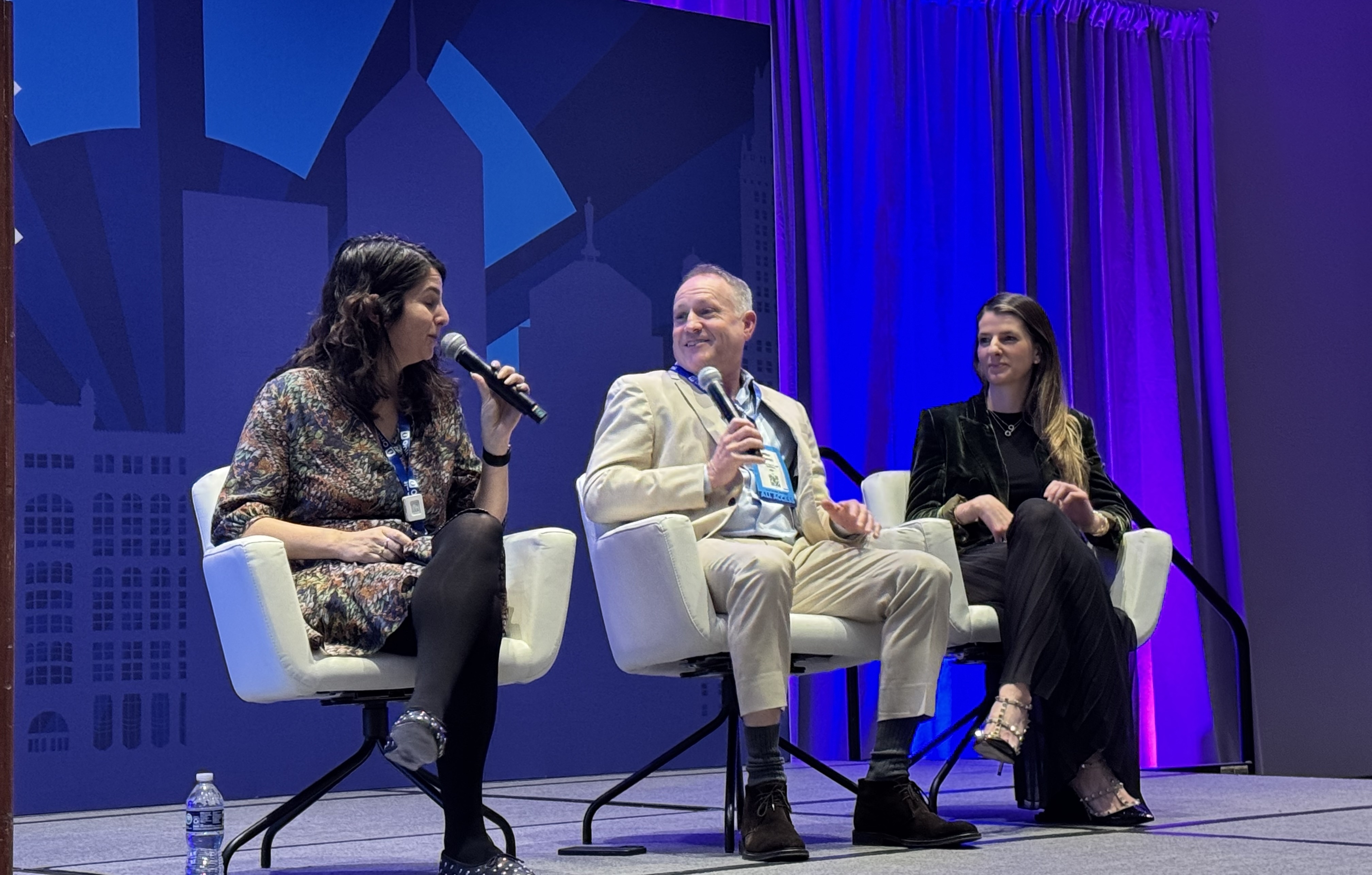
Basha Rubin (Priori), Mike Haven (Meta), and Ilona Logvinova (Herbert Smith Freehills Kramer) on 'The Great Pricing Reset' panel.
The session titled The Great Pricing Reset: How AI Is Rewriting the Rules of Legal Value provided the sharpest reframe of the week.
Priori Co-Founder and CEO Basha Rubin opened by setting the stage on where pricing in legal services has been and where it's going. In-house has grown by 50% over the last 15 years, but law firm hours have remained flat. BigLaw profits are still climbing, but rising hourly rates are driving growth, not expanding hours.
The Core, Cream, Commodity pyramid that has long organized legal work is shifting. And in a line that landed in a room full of legal ops leaders, Rubin argued we're about to see an explosion of legal work, especially as consumers can file more lawsuits with ChatGPT.
A growing pie. Cheaper does not mean less. Jevons' paradox, applied.
Ilona Logvinova, Global Chief AI Officer at Herbert Smith Freehills Kramer, then delivered arguably the central reframe of the entire conference: "The pricing question is not a pricing question. It's a value question."
Her follow-on was just as sharp. We're seeing a disaggregation of time and value. You can amplify your output if you apply the right capabilities and skills, which means the unit of measurement is changing too. Logvinova's framing—the one we keep coming back to—is the move from the billable hour to the billable token. The operational question is no longer how many hours did this take. The question now is who is minimizing token usage to leverage AI tooling more effectively.
Mike Haven closed with the session’s sharpest client-side observation. CEOs hate paying for legal services. What clients want to buy, in the end, is certainty. The most innovative firms are moving away from panels and toward success fees, and the architecture that supports that shift—what Logvinova called systems thinking—now drives value development in legal services.
Legal is one of the only professional services industries that doesn't run simulations on its own work. That's about to change.
Governance Without the Drawer
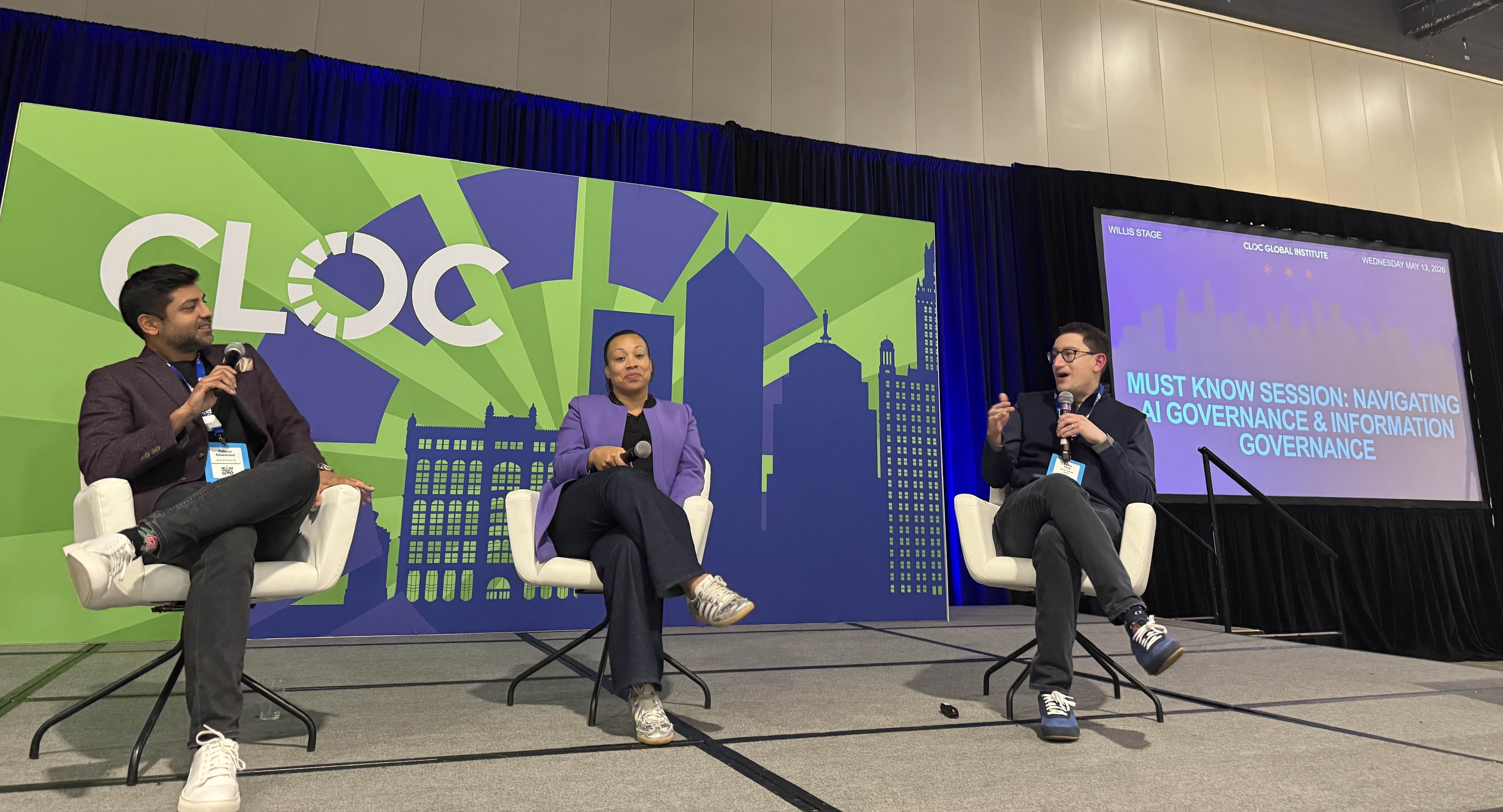
The Navigating AI Governance & Information Governance panel discussion.
The Must-Know Session on AI and information governance provided the week’s most useful governance conversation. Colin Levy, General Counsel at Malbek, posed the question every legal ops leader is trying to answer: “How do you get people to see AI governance as a priority?”
Lynee Campos, Assistant General Counsel at Delta Air Lines, walked through a three-step playbook:
-
Make sure legal as a seat at the table.
-
Inform the organization of the real regulatory and legal risks.
-
Partner with the compliance team as an ally.
Campos observed, "AI is very sexy right now, so everyone wants to get involved." The key, she explained, is that if you can articulate how AI governance helps your business partners achieve the goals they've already been mandated, they become much more likely to help out as true collaborators and co-owners of your initiatives, rather than reluctant participants.
The trap they kept coming back to: governance that gets written down and filed in a drawer. How do you match that with the reality that AI moves fast? The answer, repeatedly, was that governance has to be a cadence, not a document.
The parallel GC Priorities in 2026 panel grounded the same point in concrete terms. Christopher Chan (General Counsel, Technology, Jones Lang LaSalle), Steve Matthews (Chief Legal Officer, Chief Operating Officer and Corporate Secretary, Augment Markets), Laura Dieudonné (Legal Operations and Administration Director, Delta), and Lucy Bassli (CEO, InnoLaw Group) made the operational case from the inside.
JLL runs a multi-LLM enterprise stack of Gemini, ChatGPT, Claude, and others, accessed through an AI wrapper, because the legal team didn't want to be locked into a single platform. Delta has rolled Copilot to 300 people in External Affairs, with monthly GC department meetings where group leaders share use cases.
Bassli then named the dynamic every general counsel could recognize. "The business is teenagers having a party in your basement,” she said. “It doesn't matter if they can't use ChatGPT on your corporate environment. They have access to it on their phones."
Chan's prescription for in-house teams was practical. Use AI like a junior associate. Use it as a sparring partner for negotiation. Get executive buy-in. Get your CFO plugged in. The firms and departments doing this well aren't chasing cost savings. They're building toward transformation.
Leading Through Disruption
Heather Nevitt, Editor-in-Chief of Corporate Counsel and Global Leaders in Law at ALM, hosted a fireside chat on how legal and risk leaders keep their teams steady when the environment around them never does.
Nevitt and her guest focused on the human mechanics of that work. A few things worth carrying back:
- Watch for the signals of burnout on your team. The two most common, and the easiest to miss, are apathy and complaining. Both are often capacity issues mistaken for personality issues.
- Build in micro-joys. Small things that bring you pleasure. Pockets of time to de-stress. Leaders who don't protect their own micro-joys can't protect their teams' either.
- Block off time for yourself, even if you have to call it "busy." Otherwise, people will take that time from you. This isn't selfishness. It's stewardship.
- Rethink the 1:1. Let people come with their own list and add what you need at the end, rather than treating 1:1s as the only time management happens.
Efficiency in tech is happening on its own. What requires real leadership now is everything around it. The teams who lead with empathy will come out the other side with the people they started with.
Stronger By Design, In Practice
A few ideas survived the flight home and have continued to provoke thought in the days following the conference:
The conversation has changed. The work has just begun. From the closing remarks: "The conversation has changed on AI. Not only efficiency, but effectiveness across the entire enterprise." That shift, from talking about AI to deploying it across enterprises, was visible in every session.
Frameworks beat opinions. The CLOC Compass, Mike Haven's 4-Pillar AI Value Framework, JLL's three-core governance model, and Kessler's three E's. The field is maturing past the "should we?" question and into structured measurement of what is and isn’t working.
Accuracy is non-negotiable. Barclay Blair (Head of PiperAI) and Pia Opulencia (AI Director, Solutions Innovation, DLA Piper) made the case during their Legal Hack, Fiduciary-Grade AI at Scale. As the void at the center of legal AI grows, the problems get harder. Their close: "We can't rely on the technology without doing something else, and we're doing something else." Anyone shipping legal AI without a serious accuracy strategy is going to find out the hard way.
Thoughtful deployment is the differentiator. The tech is out there. What separates the firms and departments creating real value from the ones running pilots forever is whether they're deploying it across specialized workflows or chasing generic capability.
The human piece matters more, not less. The real constraint isn't the technology. It's how much we can absorb.
Personal brand is a discipline now. Louisa Toy, Program Manager at Amazon, framed it in her session on Building a Personal Brand in the Age of AI: "You can have the best intentions, but it's really about how people observe you and experience you." Trust builds visibility. Visibility builds opportunity. Opportunity builds career movement. Her closing line: “Use AI as a mirror, not your ghostwriter. Don't let AI speak for you, or trust walks out the door.”
It's not a panel. It's a community. The closing line of the Career Navigation session, and the truest sentence of the whole conference. CLOC is stronger by design because of the community, not despite it.
From the Steno Booth: Live From CLOC With David Cowen
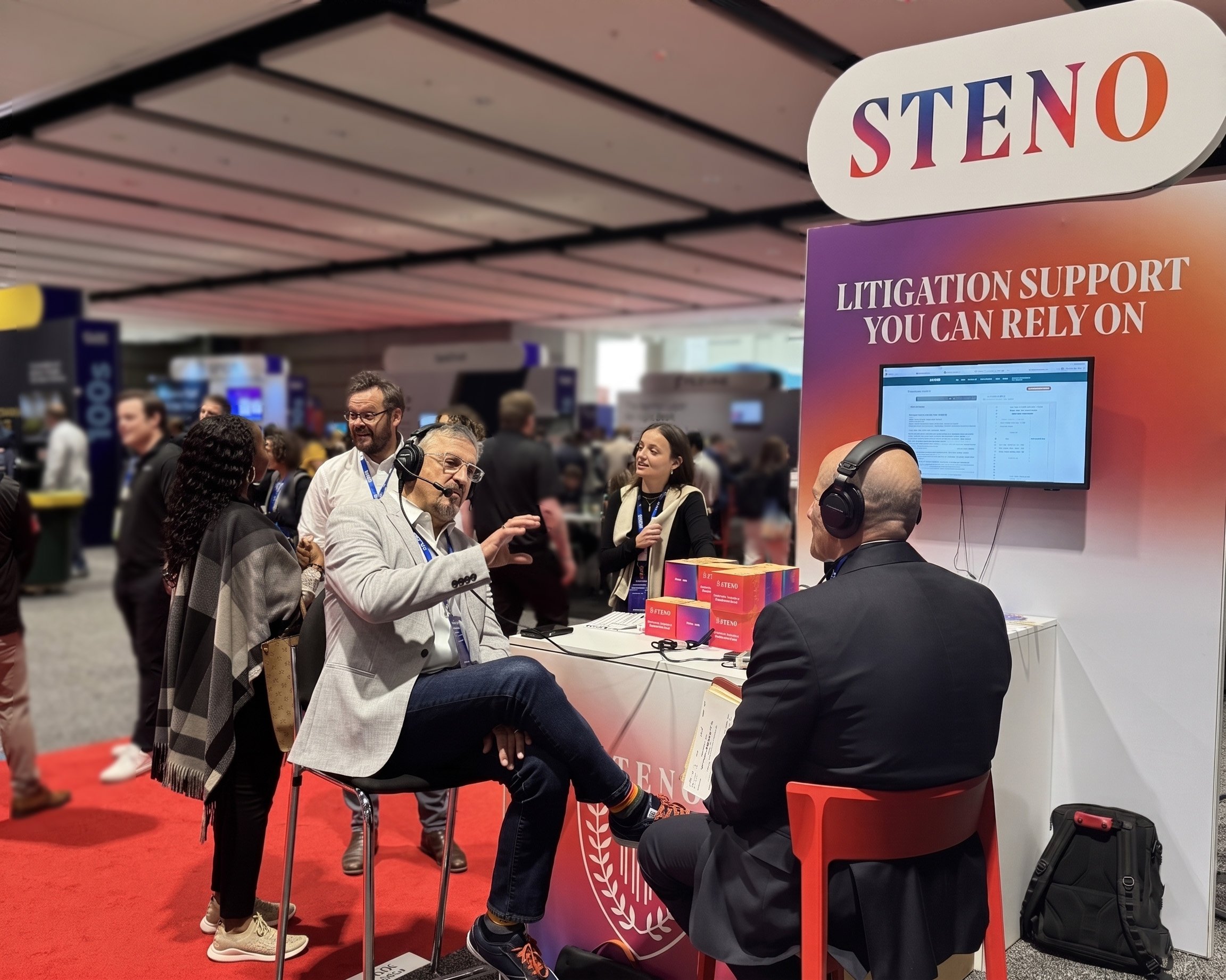
Live From CLOC podcast taping at the Steno booth.
Throughout the conference, we hosted David Cowen's Live From CLOC podcast series at the Steno booth, featuring ten conversations with future-focused legal leaders. We’re grateful to David and his guests for the depth and insight they brought to the discussions. Here’s the full list:
- Carl Morrison, Senior Manager, Legal Operations, Otsuka Pharmaceutical Companies (U.S.)
- Adam Becker, Director of Legal Operations, Cockroach Labs
- Jason Barnwell, Chief Legal Officer, Agiloft
- Colin Levy, General Counsel, Malbek
- Chad Ergun, Chief Information Officer, Womble Bond Dickinson (US) LLP
- Kim Wolfe, Senior Managing Director / SVP – CAO for Legal / Head of Legal Operations, Contracts and Innovation, State Street
- Mary Zolene Agbovi, Director, Legal Operations, CoverMyMeds
- Ari Kaplan, Principal, Ari Kaplan Advisors
- Zach Posner, Co-Founder & Managing Partner, The LegalTech Fund
- Joe Stephens, Director of Legal Solutions, Steno
Across these conversations, a throughline emerged. The pace of change is accelerating. Adoption curves that look flat are usually about to break. The people closest to the work are the ones doing the most interesting thinking about it.
And underneath all of it was the question Zack Kass put on the keynote stage at the start of the week: if you could automate everything, where would you stop? Ten different people answered it, in ten different ways, from ten different corners of the legal industry.
What's Next
CGI 2026 confirmed what we've been hearing from clients and partners. Legal ops is moving past AI adoption and into operationalization. The frameworks are sharper. The accuracy bar is rising. The conversation is shifting from "is AI worth it?" to "how do we measure whether we're using it well?"
If you want to see how Transcript Genius can give your team the same kind of structured, auditable deposition workflow Joe demoed at the Wrigley Stage, book a demo. We're ready when you are.
-1.svg)
Get the latest from The Brief directly in your inbox
AVAILABLE NATIONWIDE
The court reporting you need. The service you deserve.

When running a law firm, you have a lot on your mind: your cases, your clients, your cash flow. You need to meet your deadlines, work up your cases, and generate new business. So the last thing on your mind should be worrying about the details of depositions. Don’t let financing or technical hurdles stand in your way.
Recommended for you: