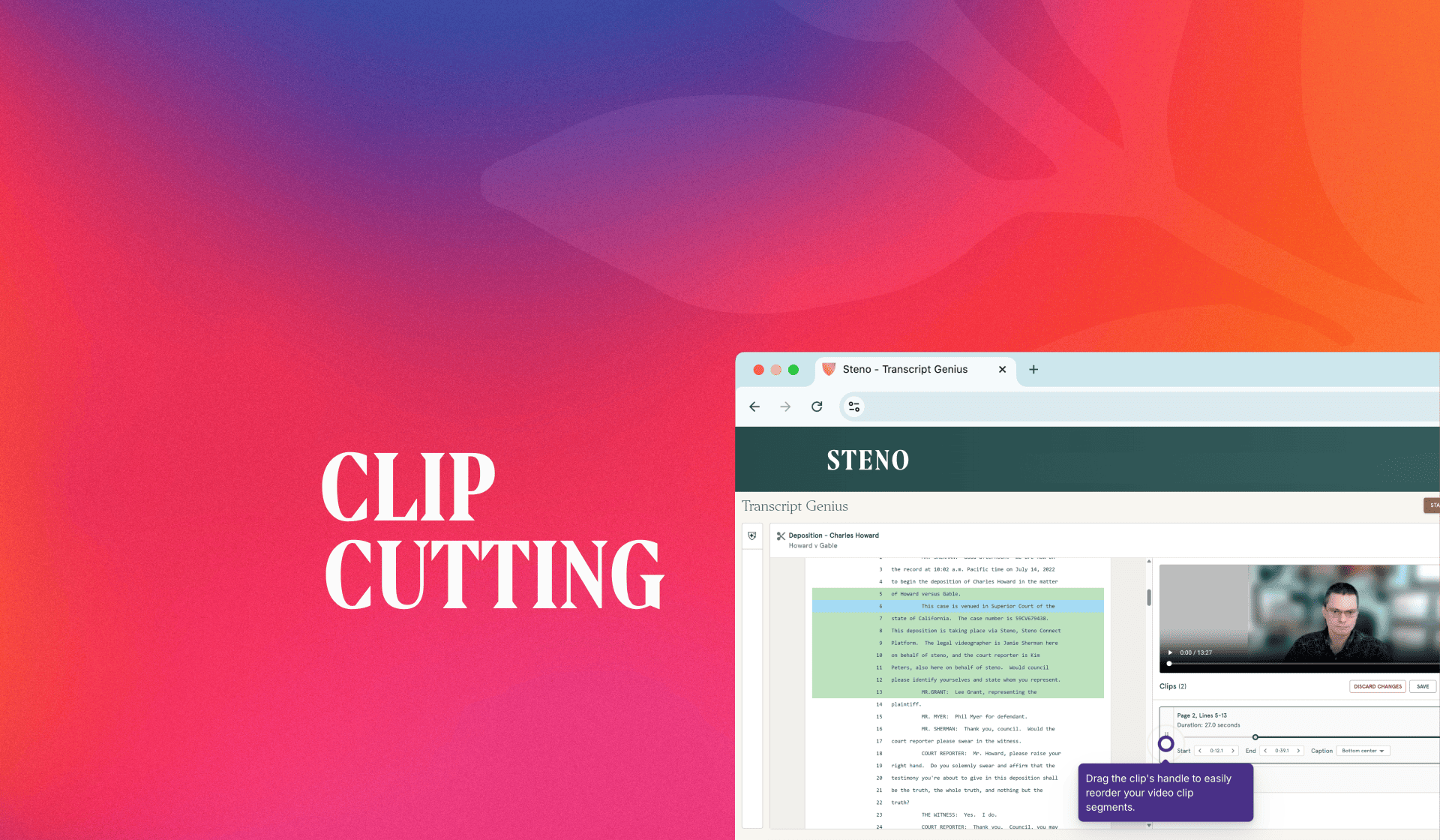
Clip Cutting is now available inside Transcript Genius. Attorneys, paralegals, and legal support teams can cut, trim, and export deposition video clips themselves, from the same interface where they already review transcripts. No separate vendor, no more waiting, no additional fee.
For most litigation teams, building those clips has traditionally meant sending page and line designations to a vendor or videographer, waiting for turnaround, paying a separate fee, then starting the process over if the clip needed adjusting. The workflow was built around handoffs and delays.
Why Video in Trial Prep Is Now an Expectation
Visual strategy in litigation, once a differentiator, has become standard practice. According to a U.S. Legal Support survey, 35% of firms relied on outside vendors for trial graphics in 2024, up from 23% in 2023—an increase of more than 50% year over year. Thirty-seven percent of firms now use a legal graphics partner for demonstratives and animations.
Deposition footage is part of the same shift. A video-recorded deposition captures what a transcript can’t, including demeanor, hesitation, and tone. That footage has strategic value throughout the case, from settlement negotiations to the courtroom.
Expectations have shifted accordingly. Legal teams are no longer evaluated on whether they have deposition video. They’re expected to use it precisely, on demand, and without altering their case strategy to accommodate a vendor’s schedule.
Where Deposition Clips Help Win Cases
Jurors follow testimony more closely when they can see and hear it than when an attorney reads it from a page. Sometimes what a witness said isn’t enough. How they said it, whether their body language matched their words, and whether their demeanor held up under interrogation are questions video answers in ways a transcript simply can’t.
Impeachment
If a witness contradicts their deposition testimony on the stand, it’s a litigator’s job to point that inconsistency out to the jury. Reading aloud from the deposition transcript can get the job done, but playing a video of the witness saying it themselves packs a serious punch.
Video is indisputable. A jury watching a witness contradict themselves on screen creates an emotional response that a printed page can’t replicate.
Testimony in Lieu of Live Appearance
Not every deposed witness is available at trial. Witnesses move, become ill, or may even die before the court date. Expert witnesses, who often have demanding schedules and may be located across the country, are not always available to appear at trial on the date the court sets. When a witness who gave significant testimony is unavailable to appear in person, video preserves what they said, along with the way they said it.
Courts generally permit video deposition testimony to be played at trial when the witness is unavailable. The clip format lets attorneys designate specific portions of a deposition for playback, so the relevant testimony can be presented without playing the full recording.
Witness Demeanor
A transcript is a record of words. It cannot capture a dismissive scoff, a drawn-out pause before answering a pointed question, or the particular brand of evasiveness that can turn a jury. If your deponent was combative or visibly uncomfortable under questioning, that’s information your transcript will never reflect.
Video preserves the deponent’s demeanor, which is part of their full testimony. Juries often remember information better when it is presented visually rather than just verbally.
Across the Case Lifecycle
Deposition clips also support other functions across the lifecycle of a case. In mediation and settlement, a well-chosen clip showing a damaging admission can shift the dynamic at the table before the case ever reaches a courtroom.
In opening and closing arguments, clips let attorneys anchor their narrative in the witness’s own voice rather than paraphrase it, a meaningful difference when credibility is on the line. And in witness prep, showing a witness footage of their own deposition is a far more effective tool than reading back a transcript, because seeing how you come across is different from being told.
What Clip Cutting Changes
Clip Cutting is available inside Transcript Genius for any deposition ordered with Text-to-Video Sync. Attorneys select start and end points directly in the transcript and can adjust the timing down to a tenth of a second. Captions are burned in by default.
When you’re ready to export, every download includes individual clip files plus a merged file with all clips in sequence, ready for courtroom playback. The entire workflow runs in your browser and is included at no additional cost.
Clip Cutting is available now. See what it looks like.









.png)


.svg)


-1.svg)


.svg)