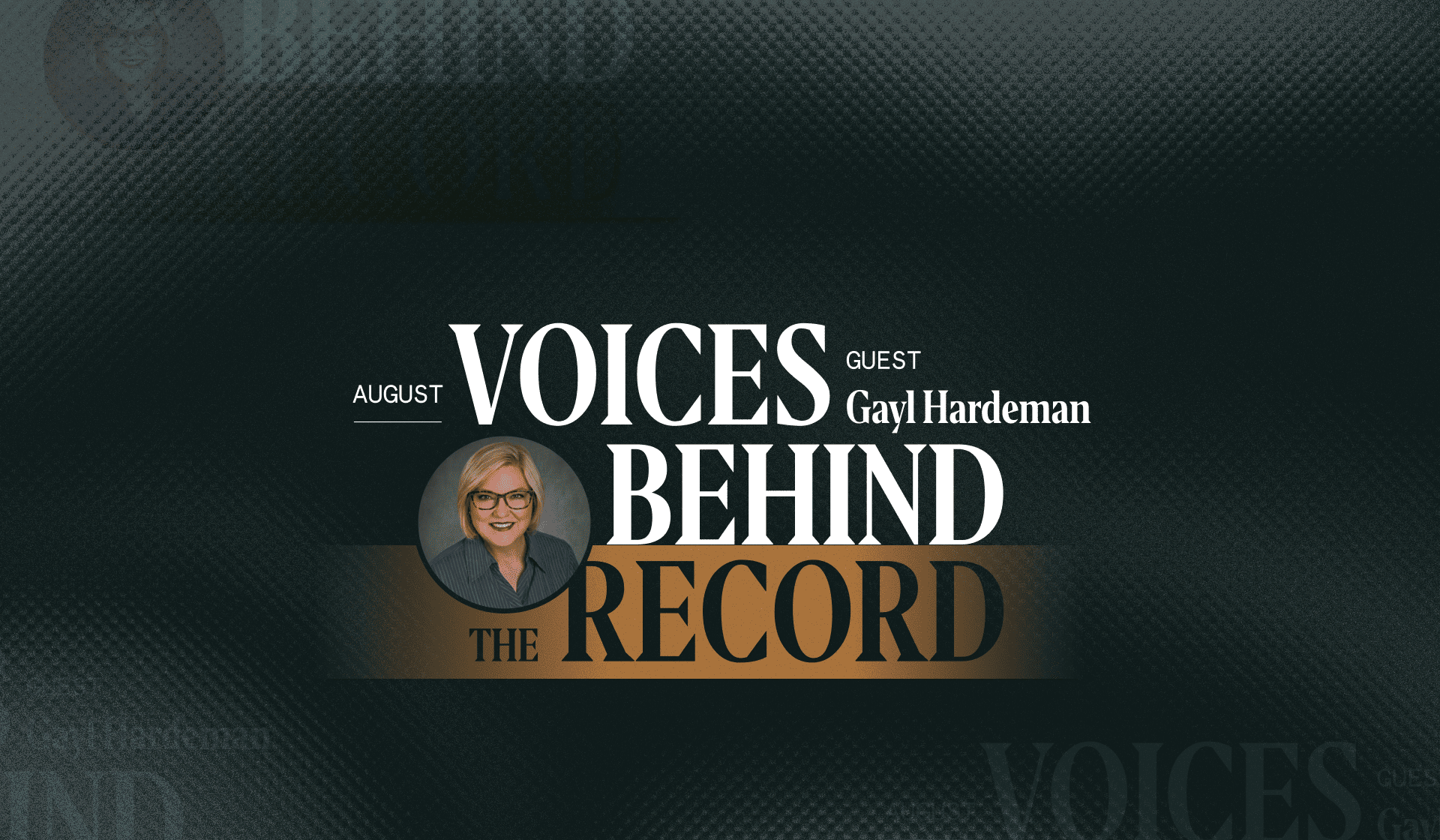
Voices Behind the Record is our ongoing series spotlighting the professionals who make up our court reporting community. Each installment takes you inside the career, craft, and mindset of a court reporter who has not only mastered the technical demands of the job, but has also stayed curious, kept growing, and pushed the profession forward.
With over 35 years in the field as a court reporter, broadcast captioner, and CART provider, Gayl Hardeman has built a career most reporters could only dream of, from captioning for heads of state to training the next generation of stenographers.
[Note: The interview has been edited for clarity.]
Origin Story
You started as an English teacher. What led you from the classroom to court reporting?
I met a court reporter at my husband's company party. She was the wife of one of his co-workers, and when she found out I'd gotten to 120 wpm in Gregg shorthand in high school (I told her that after she'd told me she was a Gregg reporter), she urged me to take machine shorthand at the local vo-tech school. I did. I loved it. A year later, I was a court reporter!
What inspired you to open the GHK School of Notereading & Court Reporting, and what did it take to get it accredited by NCRA and the Southern Accrediting Commission?
I attended my first NCRA convention and seminar when I was a young reporter in the late '70s and learned about time-saving notereaders from Ed Varallo and his notereader, Jim Gunning. I bought a notereading book from Pengad and taught my freelance firm partner/typist to read my notes. I didn't have to dictate notes any longer! Then I taught typists for reporters in our firm to noteread; rented office space to teach others two nights a week.
A steno teacher heard that I had started a "new school" and called to ask me if I needed a teacher. We got together and founded the GHK School. Val Norton was a former army sergeant and commanded discipline and hard work from her students. Our success rate was phenomenal, and it was easy to become accredited and NCRA-approved because we had everything in place. I wrote and published a note-reading book, which sold out quickly—GHK Notereading: 12 Weeks to a Career. Then computers came out, and notereaders became scopists!
Your school graduated over 85% of its students within two years, a remarkable rate. What was your admissions and training philosophy?
I had a vocabulary/punctuation admissions test, reasonable tuition, a big open space, tape duplicators, and new typewriters. I hired a nurse to teach medical terminology, a lawyer to teach legal systems and terms, and I taught English, focusing on Punctuation for Legal Transcripts, and shepherded our interns in preparing transcripts and passing the Florida CSR.
Career Highlights
You pioneered Remote CART for the Massachusetts Commission for the Deaf and Hard of Hearing back in 2008. What was it like building that from the ground up?
It was exciting! The members of ALDA, SHHH, Alexander Graham Bell Society, and other groups of individuals who were deaf or hard of hearing were strong advocates of Communication Access Realtime Translation.
Remote CART was possible only when proper audio was set up in a meeting space, and I spent many hours testing various setups with Paul Rodriguez, then the technical guru for the Massachusetts Commission for the Deaf and Hard of Hearing, and with Carl Richardson, the ADA Coordinator for the Massachusetts State House in Boston. Testing, educating, explaining, sending informational pamphlets, demonstrating remote to inquirers–it was a lot of groundwork, but it made possible a lot of communication accommodation, given the few numbers of trained CART captioners at that time available for live appearances.
You spent a year captioning news and sports in Sydney, starting right around 9/11. What was that experience like?
I'd not been able to afford a "gap year" after high school–THIS was my gap year! What a wonderful learning experience–another country, culture, dialect, viewpoint, and gastronomy. Absolutely loved the people, the company I worked for. The 9/11 experience was stranger for me because I was looking at news of my country from a foreign, albeit friendly, news source. I felt helpless and concerned for the U.S. Finding briefs for "Osama bin Laden" and al-aqbar, etc., helped me focus on my captioning work.
Any fun memories from learning soccer on the fly while captioning the World Cup?
YES! I learned that "a goose egg" meant zero. I learned about Cristiano Ronaldo, and I was part of the citywide celebration when South Korea made it to the semi-finals! KO-REE-YA! I learned lists of team members' names and briefs, and I learned to love the game of "football" and to not ever call it "soccer"!
You've reported or captioned for an incredible list of notable figures including Bill Clinton, Hillary Clinton, Bill Gates, Elie Wiesel, Laverne Cox, and Lupita Nyong'o. Is there one assignment that stands out most?
OOH, that's a hard one. I liked Bill Clinton as a speaker, Elie Wiesel for the reverence with which he spoke and whom audience members absolutely adored. I'd gone to Elie Wiesel's office in the university the week before to obtain copies of passages in Hebrew that he might recite, but I was told by his assistant that he would not release anything in advance. The night of his appearance, however, Elie did, in fact, speak in Hebrew, and I sadly had to write "(Speaking in Hebrew)" rather than display text that most of his admiring audience would have understood.
I was captioning Bill Gates at a Microsoft stockholder meeting when he was asked, "Which one of your programs is producing those great captions on the screen up there?" I smiled, gulped as he responded, "I don't know, I'll find out for you." Another presenter spoke. Bill came back to the mic and announced, "I'm sorry to say that the captions are not one of our software programs; they are being done by a human professional captioner, and I agree they are very good!" BIG SMILE.
You also donated your services to transcribe interviews with survivors of sex trafficking. What did that work mean to you?
This was over ten years ago. The project, completed with two of our captioners, opened my eyes to the evil of human beings who prey on young girls wanting desperately to break free of the chains of their bondage–poverty, abuse–and instead are pulled into a virtual prison of fear and abuse. I'm now ever alert to potentially dangerous situations and am thrilled when I see posters at airports and in restrooms alerting victims to available help. The woman for whom we transcribed these interviews created a dramatic play about the horrific issue of sex trafficking. I've not seen it yet but will.
You've worn a lot of hats in the profession, including FCRA treasurer, news editor, president, and Florida's CART representative appointed by the Governor. What drew you to that advocacy and leadership work?
Well, it's logical. If you belong to a profession and love it, you contribute to it; you don't just take from it. If with your vision and skills you can add something to your profession, that's a plus in the karma column. I had vision and organizational skills and wanted to contribute. The appointment to the Florida Coordinating Council for the Deaf and Hard of Hearing was an honor, and the people I worked with were some of the finest people I've known. Volunteering adds meaningful friendships and memories to one's life too.
Of all your certifications and awards, is there one that feels most meaningful to you? Yes. I'm most proud of the RDR, Registered Diplomate Reporter. It means I could write fast (260 wpm), and I know the meanings of a whole lot of words and write them fast. I'm also proud of making the high school swim team and competing in their longest event, because when I first tried out I couldn't swim a single lap without stopping!
Present Day
You co-own HRICART.com and the Hardeman School with your husband Michael Agostinelli. What does a day running both look like these days?
You don't want to know. (Just kidding.) Running two businesses takes a TEAM. We have an excellent C.O.O. and dedicated and smart customer managers. Our nine teachers are dedicated and professional. We are so blessed. We have frequent meetings with them to stay aligned with our mission: To provide reliable, professional captioning and outstanding stenographic training.
I personally teach two to four hours a week, attend three meetings a week, grade lots of homework papers, and oversee quality assurance from our HRI CART Captioners.
What do you hope to pass on to the reporters and captioners you're training now?
It seems a cliché to say, "Have confidence in yourself." Instead, I'll pass along a pithy quote from a book that my lovely friend Linda Holbrook shared with me: "Courage rests in the willingness to trust ourselves to survive failure." Author is Joan Chittister from her book, The Psalms–Meditations for Every Day of the Year.
Her Take on the Profession
You've seen the industry evolve for over 35 years. What's the biggest change you've witnessed in court reporting and captioning?
Oh, my! So many! From dictating notes onto a Stenorette, to having notereaders to enable doing dailies, to having scopists for the early dumb computers, to providing rough drafts, to captioning for TV and more personal CART-captioning for students and businesses, to remote work, to AI-assisted research and transcription. The biggest change is yet to come: a model of human-certified AI-assisted reporting.
What has stayed the same and will stay the same?
Reporters will need to embrace change and learn new technology more quickly. Younger people will save the record because they already embrace technology, whereas older reporters resisted it too long. We need to teach them word recognition, spelling, and punctuation of spoken language.
Voice writing and speech recognition technology have become more common. What's your take on where that fits alongside traditional stenography?
They're all fine, if there is verification of the record. Well-trained and realtime stenographers can produce a record more quickly and reliably, but they will not be able to fill the courts' needs without help from other methodologies working alongside them.
There's a lot of talk about a reporter shortage. What do you think is really driving it, and what would help?
Current reporters are getting older, and many do not want to take full-time court official positions. They're retiring or preferring to take remote depositions, part-time. Our profession's efforts to drive up enrollment in schools to meet the shortage have not been enough in the past ten years. However, with the combination of voice reporting, digital reporting, AI transcription along with human verification of transcripts coupled simultaneously with the newly increasing enrollment in court reporting schools that is happening now—thanks to TikTok videos—I believe that the needs of the court system will be covered with qualified professionals.
Do you think steno school closures and dropping enrollment are a solvable problem, or has something more fundamental shifted?
You've got old news. Thanks to TikTok and social media testimonials by court reporters, the word is out about court reporting. School enrollments are significantly higher this year. What is driving this much higher enrollment? People with education suffering layoffs from other jobs and seeing the prospects of possibly working from home and earning decent pay, becoming an important part of the judicial system, having an interesting job, being respected, and being able to earn more by working more.
Getting through court reporting school takes grit, determination, discipline, motivation, and self-confidence. Fundamentally, what percentage of the population has these traits? Add to that honesty, integrity, and time management–they are a special breed of people. Not everyone has all those traits.
How do you see AI transcription tools affecting the future of court reporting and CART work? A threat, a tool, or something in between?
I see AI transcription as a set of tools that need to be set up well, to be reliable.
What's one thing you wish people outside the profession understood about what court reporters and CART providers actually do?
We have explained steno and reporting to outsiders for years and can recite our "elevator speech" to anyone at any time. I think TikTok videos have done more for explaining what we do than any of our past endeavors.
If you could change one thing about the industry today, what would it be?
I'd urge the reporting industry to adopt this truth: that we are all in this profession together. Bottom line is that the justice system needs coverage for proceedings. Existing reporters got too comfy doing remote work during COVID, but they now must help fill the needs of the system, or the system will fill—or will have filled—its needs by employing other methods to produce the official record. The most important thing for us to remember is that we are GUARDIANS OF THE RECORD, no matter the methodology. All of us need to be serious about delivering the highest quality transcript every time.
What advice would you give someone deciding whether to enter this field now, as opposed to when you started?
While no one can predict what will happen in the future, I know it will include the use of ever-evolving technology. Justice deserves the strength of professionally trained court reporters who are not afraid to continue to learn. They are respected and needed. They may have to move to an area that has more opportunities, but they will find a good job where their skills and integrity are needed and appreciated.
Personal Side
Outside of work, you're into music and art festivals, travel, and RV trips. Any favorite trip so far?
A three-week trip with our sons in 2023: We traveled by cruise ship from Athens to Barcelona, by plane to Venice, by train to Naples, by bus to Pompeii, and by train to Rome. SO GREAT! History, art, sculpture, architecture, food, culture, and family!
And of course, tell us about your two huskies!
Mike and I love animals, and these two dogs are our buddies; they flirt for treats while I drink coffee and plan my day in the mornings. They are friendly athletes at the dog park, funsters catching backyard ball and wrestling with each other, and they are our affectionate guardians. They're hairy, they howl in harmony, and they make us smile!
Do you know a reporter who deserves a spotlight? Email lisa.thomas@steno.com and let us know!







.png)


.svg)
.svg)
.png)
.svg)



-1.svg)